Case studies
/
Beyond Blue
ZETA Motors Drivers App
ZETA Motors Drivers App
Electric Mobility
Role
Role
Role
Lead UX designer - UX research · Task modelling · IA · UI · Interaction · Prototyping
Lead UX designer - UX research · Task modelling · IA · UI · Interaction · Prototyping
Lead UX designer - UX research · Task modelling · IA · UI · Interaction · Prototyping
TEAM
TEAM
Product · Engineering · Operations · Design
Product · Engineering · Operations · Design
Formulated a unified mobile ecosystem for Zeta Motors' EV drivers aimed at mitigating operational delays and elevating safety standards. The application consolidates the entire driver lifecycle into a seamless, single-interface experience, spanning pre-trip vehicle check-ins, active route tracking and optimization, and final trip compliance.
Formulated a unified mobile ecosystem for Zeta Motors' EV drivers aimed at mitigating operational delays and elevating safety standards. The application consolidates the entire driver lifecycle into a seamless, single-interface experience, spanning pre-trip vehicle check-ins, active route tracking and optimization, and final trip compliance.

The Problem
Drivers juggle daily check-ins, route allocations, trip logs, and incident reporting using a mix of paper job cards and scattered digital tools. With the recent introduction of electric buses, drivers must also manage new responsibilities like monitoring battery charge levels and adapting to vehicle differences, often without thorough digital training. Complex workflows, frequent technology changes, and reliance on local language add to the challenge, especially during peak hours or while onboarding new drivers. They need a unified, intuitive, and localised digital experience to manage daily workflows, vehicle compliance, and electric bus operations
Drivers juggle daily check-ins, route allocations, trip logs, and incident reporting using a mix of paper job cards and scattered digital tools. With the recent introduction of electric buses, drivers must also manage new responsibilities like monitoring battery charge levels and adapting to vehicle differences, often without thorough digital training. Complex workflows, frequent technology changes, and reliance on local language add to the challenge, especially during peak hours or while onboarding new drivers. They need a unified, intuitive, and localised digital experience to manage daily workflows, vehicle compliance, and electric bus operations
Three Design Decisions
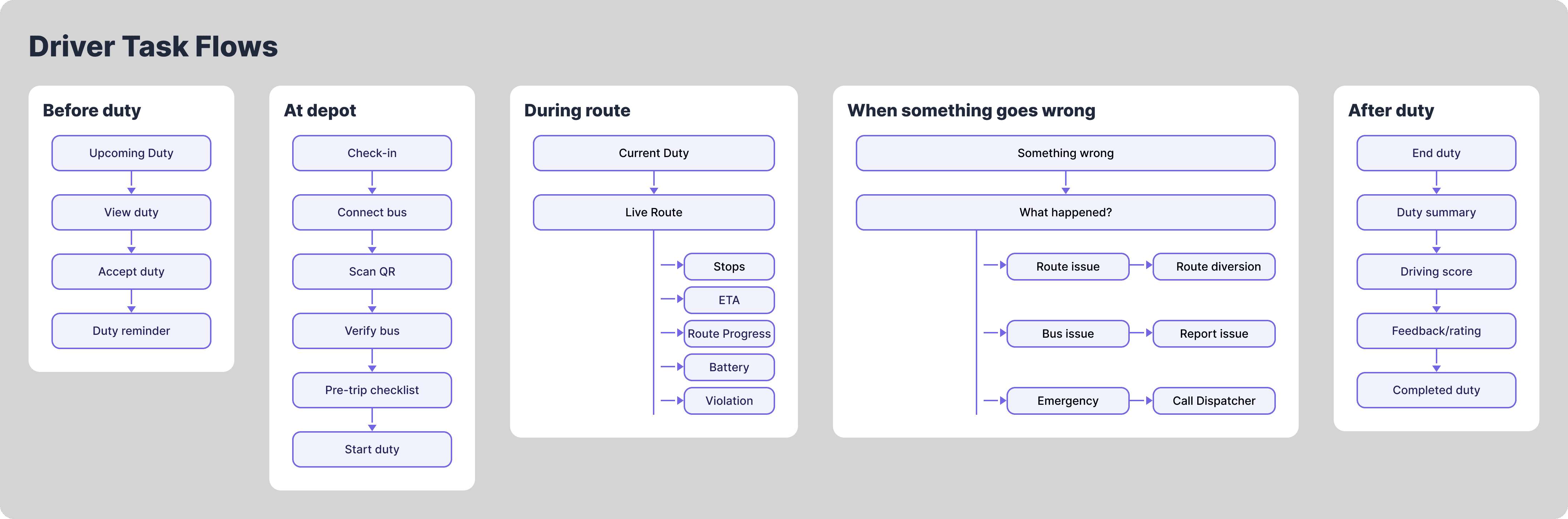
01 Prioritise the task, not the system
Instead of presenting drivers with every available piece of information, I structured the experience around what they needed to accomplish at each stage of their duty.
02 Reduce cognitive switching
Related actions and information were brought together so drivers didn't have to repeatedly move between different parts of the application.
03 Make system status visible
Important states, confirmations and changes were communicated explicitly so drivers could understand what had happened without second-guessing the system.
Results
The transformation was visible on the ground. Morning queues at the depot disappeared, and drivers who once juggled paper logs now started shifts with a single tap. Real-time visibility into charging bays and simplified reporting turned frustration into flow. Within weeks, the depot manager joked, “Ab toh drivers mujhse pehle check-in karte hain!”
The transformation was visible on the ground. Morning queues at the depot disappeared, and drivers who once juggled paper logs now started shifts with a single tap. Real-time visibility into charging bays and simplified reporting turned frustration into flow. Within weeks, the depot manager joked, “Ab toh drivers mujhse pehle check-in karte hain!”

Impact
Impact
56%
56%
Check-in time - 8 to 3.5 mins
Check-in time - 8 to 3.5 mins
35%
35%
Driver satisfaction boosted
Driver satisfaction boosted
60%
60%
Depot congestion reduced
Depot congestion reduced
A few elements from the Ideation
A few elements from the Ideation



Hi- Fi Mockups


The trade-offs
A simpler interface wasn't always the right answer. Some operational information was essential, even when it increased visual complexity. The goal was therefore not to remove information, but to establish a clear hierarchy between what required immediate attention and what could remain secondary.
A simpler interface wasn't always the right answer. Some operational information was essential, even when it increased visual complexity. The goal was therefore not to remove information, but to establish a clear hierarchy between what required immediate attention and what could remain secondary.
Design Process

“Ab toh drivers mujhse pehle check-in karte hain!”
— Depot Manager, Zeta Motors
— Depot Manager, Zeta Motors